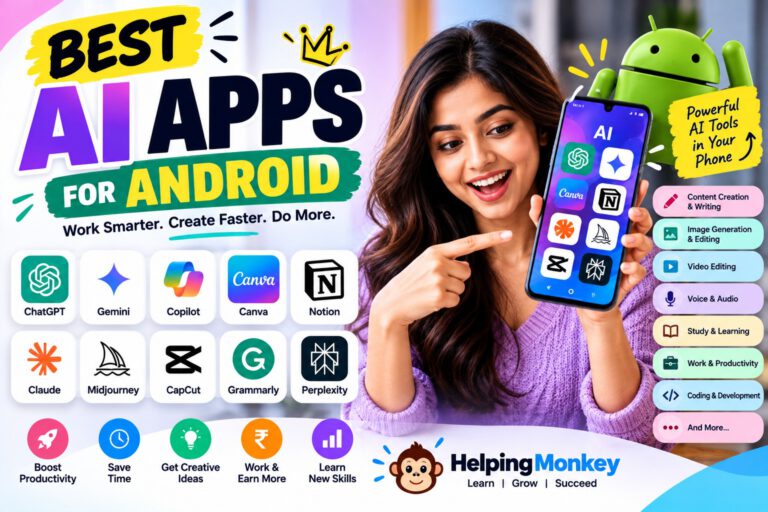
Best AI Apps for Productivity
AI is changing how people work, study, plan, communicate, and manage everyday tasks.
Instead of using AI only to generate text, you can now use AI apps to organize tasks, schedule your day, summarize meetings, manage information, automate repetitive workflows, improve writing, and turn large amounts of information into useful answers.
The goal isn’t to install dozens of AI apps.
The smarter approach is to find the few tools that remove the biggest sources of wasted time from your daily routine.
Here are some of the best AI apps for productivity and what each one is actually useful for.
🎯 What Can AI Productivity Apps Do?
AI productivity apps can help with many parts of your workday.
You can use them to:
- ✍️ Write and rewrite emails, documents, and messages
- 🧠 Brainstorm ideas and solve problems
- 📚 Research and summarize information
- 📄 Analyze documents and files
- 📅 Organize schedules and protect focus time
- ✅ Create and prioritize tasks
- 📝 Summarize meetings
- 📧 Improve email communication
- 🔄 Automate repetitive workflows
- 📊 Organize projects and team work
- 🔎 Find information across your workspace
- 🎙️ Turn conversations into notes and action items
- ⚡ Reduce repetitive administrative work
The best app depends on where you lose the most time.
🤖 ChatGPT
ChatGPT is one of the most versatile AI productivity apps because it can handle many different types of work from one place.
You can use it for writing, brainstorming, research, document analysis, coding, summarization, planning, and problem-solving.
Best for: General-purpose productivity.
Why it stands out:
- ✍️ Draft and rewrite emails
- 📄 Summarize documents
- 🧠 Brainstorm ideas
- 📊 Analyze information
- 📚 Research topics
- 📋 Create plans and checklists
- 💻 Help with coding and technical work
- 🎙️ Work through ideas conversationally
- 🔄 Turn rough notes into organized content
💡 Tip: Don’t simply ask AI to “make me productive.” Give it a specific task, your goal, the deadline, and the context it needs.
For example:
“I have five tasks to finish today. Help me prioritize them based on urgency, estimated effort, and importance.”
Pros & Cons
| Pros | Cons |
|---|---|
| ✅ Extremely versatile | ❌ Can produce incorrect information |
| ✅ Useful for many types of work | ❌ Good results depend on clear instructions |
| ✅ Can work with documents and data | ❌ Some advanced capabilities require paid access |
| ✅ Useful for individuals and teams | ❌ Can become a distraction if overused |
🧠 Claude
Claude is particularly useful when productivity involves long documents, detailed writing, analysis, or complex reasoning.
It can help turn rough ideas into polished documents, analyze information, summarize material, and assist with technical work.
Best for: Writing, analysis, and document-heavy work.
Why it stands out:
- ✍️ Improve professional writing
- 📄 Analyze long documents
- 🧠 Work through complex problems
- 📚 Summarize research
- 💻 Assist with coding
- 📝 Transform rough notes into structured documents
- 🔎 Analyze information from uploaded material
💡 Tip: Give Claude the background information and desired outcome instead of asking a vague question. The more useful context you provide, the easier it is to get a focused result.
Pros & Cons
| Pros | Cons |
|---|---|
| ✅ Strong writing and analysis | ❌ Usage limits may apply |
| ✅ Useful for long documents | ❌ Some advanced features require payment |
| ✅ Good for complex tasks | ❌ Not primarily a task-management app |
| ✅ Useful for technical work | ❌ More than casual users may need |
✨ Google Gemini
Gemini can be particularly useful for people who already work heavily with Google’s ecosystem.
It can assist with writing, research, brainstorming, information processing, and other everyday tasks. For someone who already relies on Google services, keeping AI assistance within that broader ecosystem can make the workflow more convenient.
Best for: Google-focused workflows.
Why it stands out:
- ✍️ Draft and rewrite content
- 📚 Research topics
- 🧠 Brainstorm ideas
- 📄 Work with information
- 📧 Assist with work-related content
- 🎙️ Use conversational AI
- 🔎 Explore information quickly
💡 Tip: If most of your work already happens around Google services, first look at how Gemini fits into your existing workflow instead of adding another completely separate productivity system.
Pros & Cons
| Pros | Cons |
|---|---|
| ✅ Strong Google ecosystem | ❌ Value depends on your Google workflow |
| ✅ Useful for everyday tasks | ❌ Some features vary by plan |
| ✅ Helpful for research and writing | ❌ AI output still needs checking |
| ✅ Convenient for Google users | ❌ Not primarily a task manager |
📝 Notion AI
Notion AI is useful when your documents, notes, project information, and knowledge already live inside Notion.
Instead of copying information into a separate chatbot, you can use AI alongside the workspace where your information is stored.
It can help with writing, summarization, workspace questions, meeting notes, and organizing information.
Best for: Notes, knowledge management, and organized workspaces.
Why it stands out:
- 📝 Draft and improve documents
- 🧠 Summarize notes
- 🔎 Find information in your workspace
- 📚 Ask questions about stored information
- 📋 Organize project information
- 🎙️ Turn meetings into structured notes
- ⚡ Reduce repetitive documentation
💡 Tip: Notion AI becomes much more useful when your workspace is already organized. Clean databases and well-structured pages give the AI better context.
Pros & Cons
| Pros | Cons |
|---|---|
| ✅ Works inside your workspace | ❌ Less useful if you don’t use Notion |
| ✅ Good for knowledge management | ❌ Can take time to organize properly |
| ✅ Useful for notes and documentation | ❌ Advanced AI features may require paid plans |
| ✅ Reduces copy-pasting | ❌ Not a replacement for every AI assistant |
📅 Reclaim
Reclaim focuses on one of the biggest productivity problems: not having enough time to actually do the work.
Its AI scheduling system can schedule tasks, protect focus time, manage habits, and adapt your calendar when priorities change.
Best for: Calendar management and protecting focus time.
Why it stands out:
- 📅 Automatically schedule tasks
- 🧠 Protect time for important work
- ⏰ Find suitable meeting times
- 🔄 Adjust schedules when priorities change
- 🧘 Schedule habits and routines
- 🎯 Protect focused work periods
- 🤝 Manage recurring meetings
💡 Tip: Don’t put every tiny task into your calendar. Use AI scheduling primarily for important work that repeatedly gets pushed aside.
Pros & Cons
| Pros | Cons |
|---|---|
| ✅ Automates calendar planning | ❌ More specialized than general AI apps |
| ✅ Helps protect focus time | ❌ Requires calendar setup |
| ✅ Useful for busy professionals | ❌ May be unnecessary for simple schedules |
| ✅ Can adapt to changing plans | ❌ Best results require consistent task management |
✅ Todoist
Todoist is a task-management app that focuses on helping you organize everyday responsibilities, projects, deadlines, and recurring tasks.
It is particularly useful if your biggest productivity problem is knowing what needs to be done but struggling to turn it into an organized plan.
Best for: Personal task management and daily planning.
Why it stands out:
- ✅ Create tasks quickly
- 📅 Add dates and deadlines
- 🏷️ Organize tasks with projects and labels
- 🧠 Break larger tasks into smaller steps
- 🎯 Prioritize important work
- 🔄 Manage recurring tasks
- 📱 Keep tasks synchronized across devices
💡 Tip: Instead of writing “website,” create a useful task such as “Write the homepage introduction by Friday.” Specific tasks are easier to understand and complete.
Pros & Cons
| Pros | Cons |
|---|---|
| ✅ Simple and fast | ❌ Advanced features may require a paid plan |
| ✅ Good task organization | ❌ Not a full project-management platform |
| ✅ Useful for structured daily planning | ❌ Doesn’t replace a calendar |
| ✅ Useful for individuals | ❌ Large teams may need more advanced tools |
✍️ Grammarly
Grammarly is useful when writing is a major part of your work.
Its AI writing tools can help generate drafts, rewrite text, improve clarity, adjust tone, and correct grammar while you work.
Best for: Writing and communication.
Why it stands out:
- ✍️ Fix grammar and spelling
- 📝 Rewrite sentences
- 🎯 Adjust tone
- 📧 Improve emails
- 📄 Make writing clearer
- 💼 Improve professional communication
- 🧠 Turn rough writing into polished text
💡 Tip: Use Grammarly as an editing layer rather than relying on it to write everything. Your ideas and personal voice should still come first.
Pros & Cons
| Pros | Cons |
|---|---|
| ✅ Works while you write | ❌ Some advanced features are paid |
| ✅ Good for grammar and clarity | ❌ Suggestions can sometimes be unnecessary |
| ✅ Useful for professional communication | ❌ Doesn’t replace a full AI assistant |
| ✅ Saves time on small corrections | ❌ Heavy use can make writing feel less personal |
📚 NotebookLM
NotebookLM is particularly useful when productivity means understanding information quickly.
You can provide source material such as documents and notes and then ask questions about that information.
That makes it useful for students, researchers, professionals, and anyone who regularly works with large amounts of reference material.
Best for: Research, studying, and source-based information.
Why it stands out:
- 📄 Work with your own documents
- 🧠 Summarize complex material
- ❓ Ask questions about your sources
- 📚 Organize research
- 📝 Extract important points
- 🎧 Turn information into easier-to-consume formats
💡 Tip: Instead of asking “Summarize this,” ask targeted questions such as:
“What are the three most important conclusions in these documents, and what evidence supports each one?”
Pros & Cons
| Pros | Cons |
|---|---|
| ✅ Excellent for source-based work | ❌ Requires useful source material |
| ✅ Good for research and studying | ❌ Not a general task manager |
| ✅ Helps understand large documents | ❌ Less useful for everyday scheduling |
| ✅ Reduces manual note-taking | ❌ Source quality still matters |
🔄 Zapier
Zapier focuses on a different type of productivity: removing repetitive work altogether.
Its workflows connect apps using triggers and actions, while its AI capabilities can help build workflows and automate tasks such as summarizing, classifying, and drafting.
Best for: Workflow automation.
Why it stands out:
- 🔄 Connect different apps
- 📧 Automate repetitive email workflows
- 📊 Move information between services
- 📝 Automate data-entry processes
- 🔔 Trigger notifications
- 🤖 Build AI-assisted workflows
- ⚡ Reduce repetitive administrative work
💡 Tip: Look for tasks you perform repeatedly. If you carry out the same digital action several times every week, it may be a good candidate for automation.
Pros & Cons
| Pros | Cons |
|---|---|
| ✅ Can remove repetitive work | ❌ Complex workflows take time to build |
| ✅ Connects many apps | ❌ Usage limits can matter |
| ✅ Useful for businesses | ❌ Automation errors can affect workflows |
| ✅ Can save substantial time | ❌ Requires careful testing |
🎙️ Otter.ai
Meetings can consume a significant part of the workday, and remembering everything discussed can be difficult.
Otter.ai is designed around meeting transcription and notes, helping turn conversations into searchable text, summaries, and action items.
Best for: Meetings, transcripts, and meeting notes.
Why it stands out:
- 🎙️ Transcribe conversations
- 📝 Generate meeting summaries
- ✅ Identify action items
- 🔎 Search transcripts
- 👥 Help teams capture discussions
- 📚 Keep a record of important conversations
💡 Tip: Don’t just save the transcript. Focus on the decisions, responsibilities, and action items that came out of the meeting.
Pros & Cons
| Pros | Cons |
|---|---|
| ✅ Saves manual note-taking | ❌ Transcription isn’t always perfect |
| ✅ Useful meeting summaries | ❌ Free usage may be limited |
| ✅ Searchable conversations | ❌ Meeting recording raises privacy considerations |
| ✅ Helps identify action items | ❌ Works best with clear audio |
🪟 Microsoft Copilot
Microsoft Copilot is particularly useful for people whose daily work revolves around Microsoft 365.
Its value comes from working within Microsoft’s productivity ecosystem rather than functioning only as a standalone chatbot.
Best for: Microsoft 365 productivity.
Why it stands out:
- 📧 Help with emails
- 📄 Assist with Word documents
- 📊 Work with spreadsheets
- 🎨 Help create presentations
- 🎙️ Summarize meetings
- 🔎 Find information across supported workflows
- 🧠 Assist with everyday office tasks
💡 Tip: If your company already relies heavily on Microsoft 365, check the AI capabilities available inside your existing apps before adding another standalone productivity tool.
Pros & Cons
| Pros | Cons |
|---|---|
| ✅ Deep Microsoft 365 integration | ❌ Less useful outside the Microsoft ecosystem |
| ✅ Useful across multiple Office apps | ❌ Full capabilities can require paid plans |
| ✅ Helpful for business workflows | ❌ Feature availability varies |
| ✅ Reduces repetitive office work | ❌ AI output still needs review |
⚡ How AI Saves You Time
AI productivity isn’t about doing more tasks at once. It’s about reducing unnecessary work.
For example, instead of manually reading every email, deciding what needs a response, writing replies, and creating follow-up tasks, AI can help you:
📧 Summarize important emails
✍️ Draft replies
✅ Identify action items
📋 Turn them into tasks
📅 Help plan the next steps
The idea is simple: let AI handle repetitive work so you can focus on work that actually needs you.
🧩 Which AI Productivity App Should You Choose?
Start with the problem rather than the app.
If writing takes too much time:
→ ChatGPT, Claude, or Grammarly
If your calendar is always overloaded:
→ Reclaim
If you forget or lose track of tasks:
→ Todoist
If your information is scattered across documents:
→ Notion AI or NotebookLM
If meetings consume too much time:
→ Otter.ai
If you repeat the same digital tasks every week:
→ Zapier
If your company uses Microsoft 365:
→ Microsoft Copilot
This approach is much better than installing ten AI apps and hoping productivity improves.
⚡ A Simple AI Productivity Workflow
You don’t need a complicated AI stack.
A simple setup could look like this:
Morning ☀️
Use Todoist to identify your most important tasks.
Planning 📅
Use Reclaim to protect time for those tasks.
Work ✍️
Use ChatGPT or Claude when you need help writing, researching, analyzing, or brainstorming.
Meetings 🎙️
Use Otter.ai to capture discussions and action items.
Information 📚
Use NotebookLM or Notion AI when you need to understand or organize large amounts of information.
Repetitive work 🔄
Use Zapier to automate tasks that don’t require constant human attention.
You don’t need every step. Choose only the parts that solve an actual problem in your workflow.
🚫 Don’t Let AI Become Another Productivity Problem
AI can save time, but it can also waste time.
You can easily spend an hour testing different AI tools instead of completing the task you were supposed to finish.
Watch out for:
- 📱 Constantly switching between AI apps
- 🔄 Rewriting the same prompt repeatedly
- 🧠 Using AI for tasks that take seconds to do yourself
- 📚 Generating information you never actually use
- ⚙️ Building complicated automations for simple tasks
- ✍️ Spending more time editing AI output than doing the work
- 🔔 Allowing too many notifications and integrations
The best AI tool is often the one that quietly removes work from your day.
🔐 Be Careful With Sensitive Information
Productivity apps can potentially process emails, documents, meeting transcripts, customer information, business data, and other sensitive material.
Before connecting an AI tool to your workflow, consider:
- 🔒 What information it can access
- 👤 Who can access the information
- 📋 How data is stored
- 🔗 Which third-party apps are connected
- 🛡️ Available privacy and security controls
- ⚙️ What actions the AI is allowed to perform
Don’t give an AI tool access to information or systems it doesn’t need.
For important business workflows, human approval can also be useful before an AI system sends messages, changes records, or performs other consequential actions.
🏆 Best AI Apps for Productivity at a Glance
| AI App | Best For | Ideal User |
|---|---|---|
| 🤖 ChatGPT | General AI assistance | Almost everyone |
| 🧠 Claude | Writing and complex analysis | Writers and professionals |
| ✨ Gemini | Google workflows | Google users |
| 📝 Notion AI | Knowledge management | Teams and organized workspaces |
| 📅 Reclaim | Calendar and focus time | Busy professionals |
| ✅ Todoist | Task management | Individuals and small teams |
| ✍️ Grammarly | Writing and editing | Anyone who writes regularly |
| 📚 NotebookLM | Research and documents | Students and researchers |
| 🔄 Zapier | Workflow automation | Businesses and power users |
| 🎙️ Otter.ai | Meetings and transcripts | Meeting-heavy professionals |
| 🪟 Microsoft Copilot | Microsoft 365 | Microsoft users |
❓ Frequently Asked Questions
1. What is the best AI app for productivity?
ChatGPT is one of the strongest all-around options because it can help with writing, research, brainstorming, analysis, planning, and many other tasks. However, specialized apps such as Reclaim, Todoist, and Zapier can be better for specific productivity problems.
2. Can AI really improve productivity?
Yes. AI can reduce the time required for tasks such as writing, summarizing, scheduling, research, meeting documentation, and repetitive digital work. The biggest gains usually come from connecting AI to an existing workflow rather than using it only for occasional questions.
3. Which AI app is best for daily task management?
Todoist is a strong choice for managing personal tasks, deadlines, priorities, and recurring work. If scheduling those tasks on your calendar is also important, an AI calendar tool such as Reclaim can complement it.
4. Which AI app is best for writing emails?
ChatGPT, Claude, Grammarly, and Microsoft Copilot can all help with email writing. Grammarly is particularly useful for editing and polishing, while ChatGPT and Claude are useful when you need to generate a complete draft from context.
5. Which AI app is best for meetings?
Otter.ai is a strong option for meeting transcription, summaries, and action items. Other productivity platforms also provide AI meeting features, so your existing meeting software should also be considered when choosing a tool.
6. Which AI productivity app is best for research?
NotebookLM is particularly useful when you already have documents, reports, notes, or other source material that you need to understand. ChatGPT, Claude, and Gemini can also help with broader research and analysis.
7. Can AI automate repetitive tasks?
Yes. Tools such as Zapier can connect different applications and automate repetitive workflows. The best candidates are tasks that follow predictable steps and don’t require constant human judgment.
8. How many AI productivity apps should I use?
There is no ideal number. For many people, one general AI assistant plus one or two specialized tools is enough. Adding more apps can actually reduce productivity if you spend too much time managing them.
9. Are AI productivity apps free?
Many AI productivity apps offer free plans or limited free features. More advanced capabilities, higher usage limits, team features, and automation often require paid plans. Pricing and plan features can change, so check the provider’s current pricing before subscribing.
10. What is the biggest mistake when using AI for productivity?
Using AI without a clear purpose. If you’re constantly switching between tools, rewriting prompts, checking unnecessary AI output, or building complicated workflows, AI can create more work instead of reducing it.